How to Improve Recording Video and Audio Quality in oCam
How to Improve Video Recording Quality
By default, oCam uses the
MPEG-4 video codec.
The MPEG-4 codec, which is used by default, provides medium-level video quality by nature. However, it is set as the default because it is suitable for recording on low- to mid-spec computers, does not use a hardware encoder, and offers good software compatibility ( it can be played in most video players ).
If you have an NVIDIA graphics card ( GTX 600 series or later for desktops, or GTX 650M or later for laptops ) or if your CPU performance is high, you can improve video quality by recording with the NVENC H.264 encoder or the Open H.264 encoder.
As shown below, click the Codec button in the oCam main window and select either NVIDIA NVENC H.264 ( your graphics card must support it, and if it does not, an error will occur and recording will fail when you start recording ) or the Open H.264 codec to record.
For the Open H.264 codec, you need to set Recording - General - Quality to Very High in the settings to get the best video quality, as shown below. ( In the case of the NVIDIA NVENC H.264 codec, the settings below do not apply. You can change its settings from Codec - Hardware Encoder Settings in the oCam main window. )
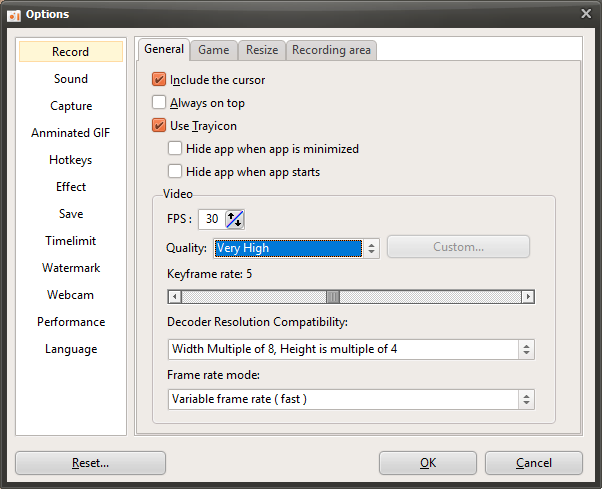
* In the case of the Open H.264 codec, setting the quality to Very High provides good video quality, but it uses a lot of CPU resources, so frame rates may drop significantly when recording games. If your system performance is not sufficient, we recommend using the MPEG-4 codec.
* In the case of the NVIDIA NVENC codec, because it is a hardware encoder, it causes almost no frame drops during game recording and offers the best recording performance among all built-in codecs in oCam. If your graphics card supports it, using the NVENC codec is the best option.
* When using the NVIDIA NVENC codec, some games use a large amount of GPU memory, and encoding also uses a large amount of GPU memory, so recording may fail if GPU memory is insufficient.
* The MP4 container was used in the example above, but it can also be used with MKV, M4A, MOV, and AVI containers.
How to Improve Audio Quality
By default, oCam uses the
AAC audio codec ( 192 kbps ).
To change the sample rate or bitrate of the audio codec, click the Codec button in the oCam main window, then click Audio Codec Settings.
Then the following window will appear.
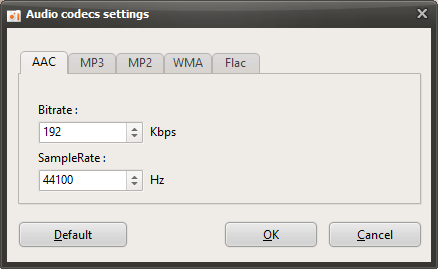
As shown in the image above, the supported audio codecs are AAC, MP3, MP2, WMA, and Flac.
Personally, I recommend using the AAC codec because it is the most widely used and offers the best compatibility.
You can improve audio quality by changing the bitrate or sample rate.
For the AAC codec, the maximum supported bitrate is 512 kbps, and the maximum sample rate is 96000 kHz.
If you want to record losslessly, you can use the Flac codec, but the recording file size may become large.
To change the audio codec you want to use for recording, click the Codec button in oCam, select the container you want ( for example, assuming you are using MKV ), and then select a codec in that container that includes the audio codec you want before recording.
Today's News/Tips
What to Do If the "Failed to url_fopen" Error Message Appears and Recording Does Not Start
When creating a recording file in oCam, an error may occur if the file cannot be saved to the save path specified by the user. This issue is usually caused by access permissions for the save path or an incorrect path setting. Below is a detailed explanation of how to change the save path to resolve this problem.
To fix the recording file save error, the most effective method is to change oCam's save path to a different location. Please follow the steps below:
1. In the oCam main window, click 'Tools' in the top menu, then select 'Options'.
2. When the Settings window opens, click the 'Save' category in the left menu.
3. In the 'Save' tab, find the 'Save Path' item, check the currently configured path, and change it to a new location.
4. After making the change, click the 'OK' button to save the settings.
By default, it is recommended to set the save path to the Desktop. The Desktop generally has the access permissions needed for all programs to create files, so save errors are less likely to occur. For example, if you set the Desktop path to `C:\Users\[User Name]\Desktop`, in most cases the recording file will be saved without errors.
After changing the save path, restart oCam and try recording again to check whether the problem has been resolved. If the issue continues, it is also a good idea to check whether the selected folder has write permission and whether there is enough disk space.