What to Do If the "Cause: failed to avio_open(error=-13)" Error Occurs During Recording
This error may occur because AhnLab V3 or Avast falsely detects oCam as suspicious. Below is a detailed explanation of how to resolve the issue for each antivirus program.
For AhnLab V3, if oCam is being falsely detected, you can resolve the issue by adding the `oCam.exe` file in the oCam installation folder to the scan exclusion list.
1. Open the AhnLab V3 program.
2. Go to the Settings menu and find the 'Scan Exclusions' or 'Exclusion Settings' option.
3. In the 'File/Folder Exclusions' section, click the 'Add' button.
4. Go to the folder where oCam is installed, for example `C:\Program Files\oCam`, and select the `oCam.exe` file.
5. Add it to the exclusion list and save the settings.
6. Run oCam again and check whether recording works normally.
* There may also be a conflict with the anti-ransomware feature.
For example, if drive E is set as a ransomware-protected drive and oCam's save folder is also set to drive E, an error may occur during recording. This happens because the anti-ransomware feature restricts file writing on that drive, preventing oCam from saving the video file.
In this case, keep drive E as a ransomware-protected drive and set oCam's recording save folder to drive C or D instead.
Because drive E is configured as a ransomware-protected drive, file creation and modification are restricted for security purposes, so programs such as oCam are blocked from saving files there. Therefore, the simplest solution is to move the save path to drive C or another unrestricted location.
If you want to continue using drive E, you may also consider temporarily disabling the anti-ransomware setting or adding the oCam executable file (`oCam.exe`) as an exception in the security policy for that drive.
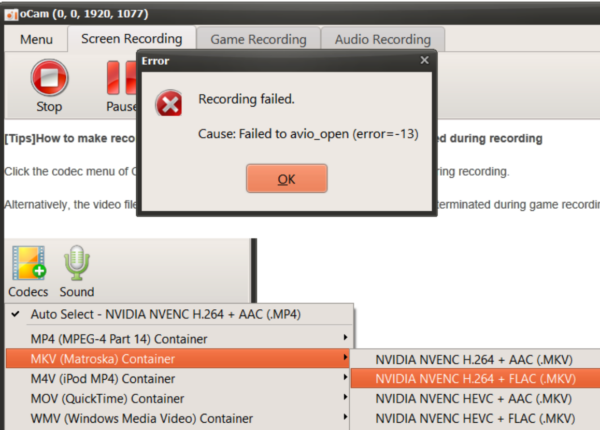
For Avast, if oCam is falsely detected, a pop-up message like the one below may appear. In that case:
1. In the pop-up, click the 'Allow App' button to register oCam as a trusted program.
2. This will remove the error and allow oCam to work normally.
If the pop-up does not appear, you can adjust the allow settings manually:
1. On the Avast main screen, click 'Menu' and then select 'Settings'.
2. Go to the 'Blocked & Allowed Apps' section.
3. Click the '+ Allow App' button and add the oCam executable file (`oCam.exe`).
4. Once oCam has been added to the allowed apps list, save the setting and run oCam again. Recording should then work without any issues.
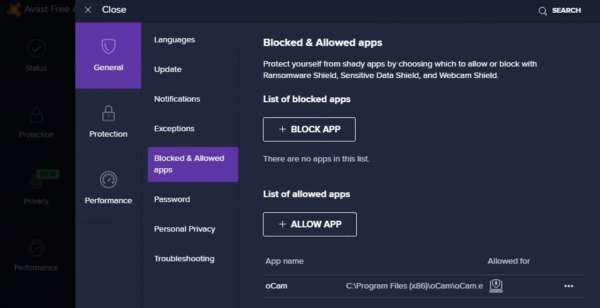
As an alternative, you can also disable part of the protection feature:
1. Open the 'Protection' menu on the Avast main screen.
2. Find the 'Ransomware Shield' option and turn it off.
3. Disabling Ransomware Shield may resolve the error related to oCam.
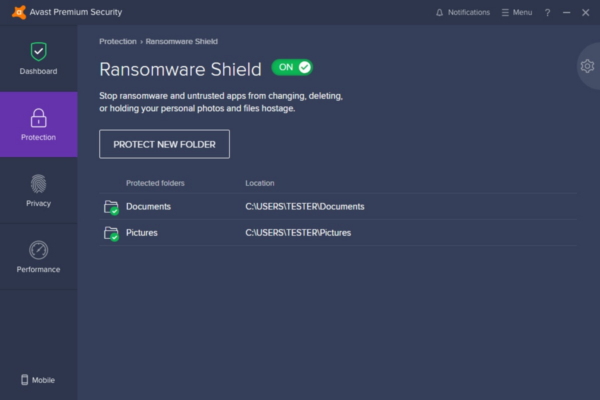
You can choose and apply whichever method is more convenient. If the problem continues even after changing the antivirus settings, it may also help to contact AhnLab or Avast customer support.
Today's News/Tips
The "Failed to initialize sound library." Error Appears When Recording Starts
When recording with oCam, sound-related errors may occur. To prevent this, it is important to first check whether sound playback is working properly on your PC. If you try to record on a PC where sound playback is not available, an error is likely to occur. Below is a detailed explanation of how to record with oCam in an environment where sound playback is unavailable and how to configure the settings to avoid errors.
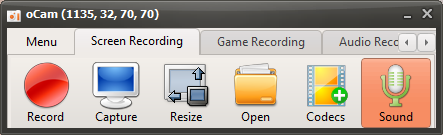
If sound is not playing properly on your PC, you can solve the problem by disabling oCam's system audio recording feature. Please follow the steps below:
1. Launch the oCam main window.
2. In the main window, click the 'Sound' button.
3. When you click it, a pop-up menu will appear, and in most cases the 'Record System Audio' option will be checked by default.
4. Click the 'Record System Audio' item to uncheck it.
With this setting, oCam will not try to record system audio, so you can continue recording without errors even on a PC where sound playback is not available. This setting is especially useful in environments where system audio is not output due to sound driver problems or hardware issues.
Before recording, always check the sound playback status of your PC and apply the setting above if necessary to create a stable recording environment. If you want to resolve the sound playback issue more fundamentally, updating the sound driver or checking the device's sound settings is also a good approach.