Where are the recorded video files saved, and how can I change the save location?
In oCam, recorded video files are automatically saved to the folder you specified as the save path.
By default, oCam saves files to the default folder configured on your computer.
To check this folder, first run the oCam program and go to the main screen.
Click the Open button on the main screen, and the folder where recorded video files are saved will appear.
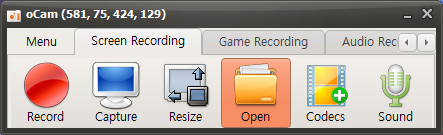
Clicking this button automatically opens Windows Explorer so you can check the folder directly.
If you want to change the save path, click the Settings button on the oCam main screen.
When the Settings window opens, go to the Save tab at the top and find the save path setting option.
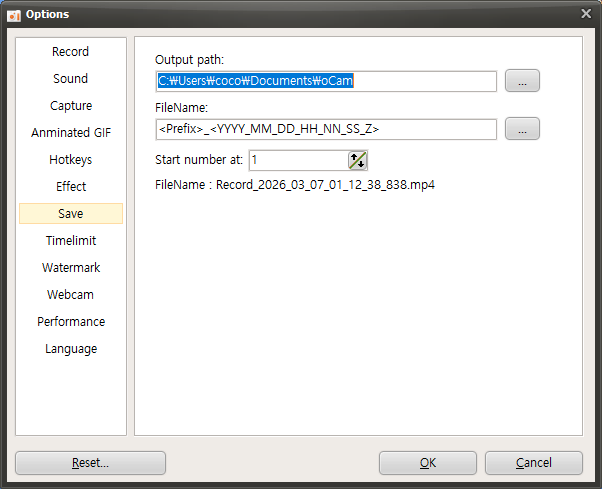
You can change the path by clicking here and selecting a desired folder.
After saving the changed path, all future recorded video files will be saved to the new location.
In addition, setting the save path to a folder you use often makes file management much more convenient.
Today's News/Tips
Can I record only the computer system sound and save it as MP3?
Not only video recording, but audio recording is also now supported.
You can record through the following simple steps.
In the oCam main window, click the Sound tab at the top.
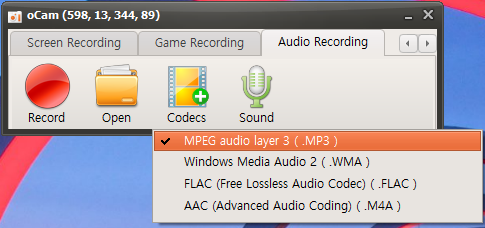
Then the mode is changed to audio recording.
In this state, when you click the Record button, system sound is recorded instead of screen recording.
Then click the Codec button as shown below to set which audio file type to save.
(Currently, MP3, WMA, FLAC, and M4A extensions are supported.)
1. MP3 (MPEG-1 Audio Layer 3)
- Features: MP3 is the most widely used audio compression format, developed in the 1990s.
- Compression method: It uses lossy compression, which greatly reduces file size.
- Sound quality: Some audio data is lost during compression, so quality may drop compared to the original. However, at 192 kbps or higher, most users may not notice a clear difference.
- File size: About 2.4 MB per minute at 320 kbps, which is relatively small.
- Compatibility: It is supported on almost all devices and software, making it suitable for streaming, downloading, and playback.
- Use case: Commonly used for portable music players, online streaming, and everyday music listening.
2. WMA (Windows Media Audio)
- Features: An audio format developed by Microsoft, designed as an alternative to MP3.
- Compression method: Supports both lossy and lossless compression modes.
- Sound quality: Claimed to provide better quality than MP3 at the same bitrate, though the actual difference is often minimal. Lossless WMA preserves original audio quality.
- File size: Similar to MP3 in lossy mode; in lossless mode, files are much larger (about 10~20 MB per minute).
- Compatibility: Strong support in Windows environments, though compatibility may be weaker on other platforms such as macOS or some Android devices.
- Use case: Mainly used in Windows-based software and Microsoft products such as Xbox; DRM support makes it suitable for protected content distribution.
3. FLAC (Free Lossless Audio Codec)
- Features: A popular lossless audio format among audiophiles.
- Compression method: Uses lossless compression, preserving 100% of the original audio data.
- Sound quality: Provides original-quality audio with no loss, suitable for high-resolution playback.
- File size: Much larger than MP3, but about 50~70% smaller than the original WAV file (roughly 20~30 MB per minute).
- Compatibility: Supported by most advanced audio players and software, but may be difficult on some low-spec or older devices.
- Use case: Suitable for high-quality music listening, audio archiving, and studio work where preserving quality is important.
4. M4A (MPEG-4 Audio)
- Features: An MPEG-4 based audio format mainly used by Apple, including AAC (Advanced Audio Coding) and ALAC (Apple Lossless Audio Codec).
- Compression method: Supports lossy AAC and lossless ALAC.
- Sound quality: AAC is more efficient than MP3 and often provides better quality at the same bitrate. ALAC preserves original quality as lossless.
- File size: AAC is similar to or slightly smaller than MP3 (about 2 MB per minute), while ALAC is similar in size to FLAC (about 20~30 MB per minute).
- Compatibility: Strongly supported on Apple devices (iTunes, iPhone, iPad) and macOS; some Android devices or other platforms may require additional codecs.
- Use case: Mainly used in iTunes, Apple Music streaming, and podcasts, with AAC suitable for streaming and efficient storage.
Additional tips
- If you prioritize quality: choose FLAC or M4A (ALAC).
- If you prioritize file size and compatibility: choose MP3 or M4A (AAC).
- In Windows environments: WMA is also a good option, but MP3 may be more universally compatible.
- For Apple device users: M4A is most suitable, and AAC is especially good for streaming and saving storage.