FAQ (36)

How to Add Your Own Watermark

A watermark is an image added to your video to identify its source, since others may copy or repost it.

To add a watermark, follow these steps.

1. In the oCam main window, click Tools - Options from the menu.

2. When the Settings window appears, click Watermark on the left.

You can configure the watermark as shown below.
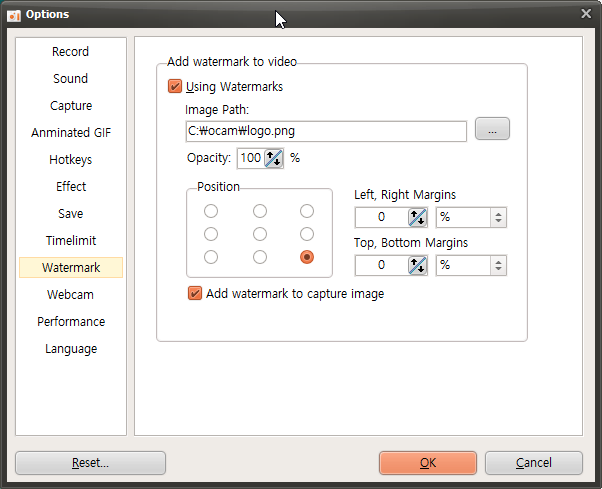


If you check Use Watermark, the image set in the image path will be displayed in the recorded video.

If the opacity is 100%, the image will be shown as is. The lower the value, the more transparent it becomes.

The coordinates set the position where the watermark will appear in the video.

Set the following image as the watermark,

( The copyright for this image belongs to http://ploupdesign.fr/. )



and when you start recording, the image will appear as shown below.
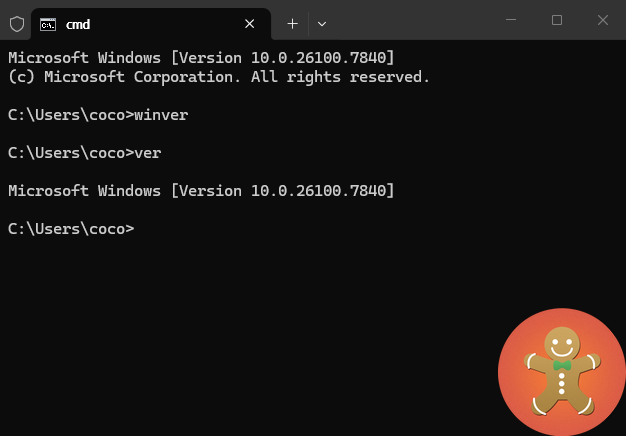


Watermark images support PNG, JPG, and BMP formats, and PNG files with alpha channels are also supported.

To create your own watermark, search for "create watermark" on a search site.


Today's News/Tips

Useful Tips for Microphone Recording in Windows 7 or Later

When recording microphone and system audio with oCam, knowing how to adjust the sound balance and audio quality is an important factor that can greatly improve recording quality. Below is a detailed guide to the settings and tips related to microphone and system audio recording.


1. If you want to record only the microphone  

If you want to record only the microphone audio and exclude system audio, click the 'Sound' button in the oCam main window. In the sound settings menu, uncheck the 'Record System Audio' option. With this setting, oCam will record only the microphone input without system audio, allowing you to focus on the microphone sound.


2. If you want to record both the microphone and system audio  

To record both microphone and system audio at the same time, click the 'Sound' button in the oCam main window, then select both the 'Record System Audio' and 'Microphone' options. With this setting, you can record system audio such as game sound or background music together with voice input from the microphone, such as commentary or conversation. This is useful when you want to create a video in which both sounds blend naturally.


3. If the microphone volume is too low  

If the microphone volume is too low and hard to hear, you can adjust the microphone volume through the Windows sound settings. Follow the steps below:  

- Open 'Control Panel' from the Start menu and click 'Sound'.  

- In the Sound settings window, go to the 'Recording' tab.  

- Find the microphone you are using in the list of recording devices and double-click it to open the 'Microphone Properties' window.  

- In the 'Levels' tab, adjust the 'Microphone Volume' slider to increase the base volume, and if necessary, enable the 'Microphone Boost' option to make the sound louder. With this setting, the microphone audio will be recorded more clearly and at a higher volume.


4. If the system audio is too loud and drowns out the microphone  

If the recorded system audio is too loud and makes the microphone hard to hear, you should reduce the system audio volume. You can use the following two methods for this:  

- Adjust the volume inside the playback program: If the program producing the system audio, such as a game or media player, has its own volume control option, lower the volume in that program. This reduces the system audio level during recording and helps balance it with the microphone audio.  

- Use the Windows Volume Mixer: If the program itself does not allow volume adjustment, right-click the speaker icon in the tray at the bottom right of the taskbar. From the menu that appears, select 'Open Volume Mixer'. This will open the mixer window, where you can adjust the volume of each currently running program individually. Lower the volume slider for that program to reduce the system audio.  

*Note*: Lowering the overall Windows speaker volume does not affect the volume of the recorded sound, so you must adjust the volume of the individual program.


5. If increasing the microphone volume only increases noise and the audio quality is poor  

If you increased the microphone volume as described in section 3 but the noise became worse or the audio quality is still unsatisfactory, then instead of forcing the microphone volume too high, you should also reduce the system audio appropriately. As explained in section 4, lower the system audio volume to balance it with the microphone audio so that the microphone voice can be heard more clearly. During this process, carefully adjust the balance between the microphone and system audio to find the best sound quality.


6. If you want to further improve microphone quality or completely remove noise  

If you want to maximize microphone quality or reduce noise, software settings alone may have limitations. In that case, the most effective solution is to purchase a professional audio interface and a high-quality microphone. Many standard microphones produce a lot of noise or have low audio quality, making it difficult to fully compensate through software. Therefore, using a high-quality audio interface and a matching microphone can give you clear audio with minimal noise. For example, combining a condenser microphone with a USB audio interface can deliver professional-level recording quality.


Use the methods above to adjust the microphone and system audio in oCam the way you want and create the best recording environment. By fine-tuning each setting carefully, you can record better sound quality and more balanced audio.

OhSoft - secretfolder The File Appears to Be Encrypted
oCam - howto How to Record Gameplay