What Video Codecs and Container Formats Are Supported?
oCam supports a range of video codecs and container formats so that users can choose from various recording options.
Below is information about the video codecs supported by oCam.
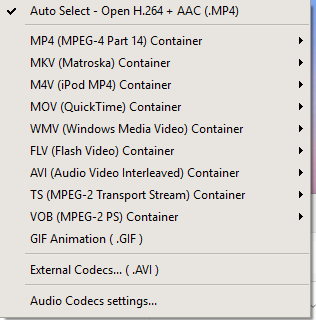
* How to Check Supported Video Codecs
You can check the video codecs supported by oCam simply by clicking the 'Codec' button in the oCam main window. From this menu, you can easily view and adjust the list of available codecs and their settings.
* Supported Video Codecs
oCam supports the following video codecs for different container formats. Each codec is encoded according to the selected container format:
- MPEG-1: Used with the AVI container format and widely compatible as an early digital video compression standard.
- MPEG-2: Used with the TS and VOB container formats and suitable for DVDs and broadcast streaming.
- MPEG-4: Used with a wide range of container formats, including MP4, MKV, M4V, MOV, FLV, and WMV. oCam uses MPEG-4 as its default codec, offering high compression and good quality.
- XVID: Used with the AVI container format. It is an open-source codec based on MPEG-4, and oCam internally uses the MPEG-4 codec with only the FourCC set to XVID.
- OpenDivx: Used with the AVI container format, also based on MPEG-4, with the FourCC set to OpenDivx.
- Microsoft MPEG-4 Part 2: Used with the AVI container format and set as oCam's default codec. It can be played in most video players, such as Windows Media Player, without installing additional codecs.
- Microsoft MPEG-4 Part 3: An additional option available for the AVI container format, offering compatibility and quality.
* Relationship Between Container Formats and Codecs
oCam supports various container formats, and according to the image you provided, the supported container formats are as follows:
- MP4 (MPEG-4 Part 14): Uses the MPEG-4 codec.
- MKV (Matroska): Uses the MPEG-4 codec.
- M4V (iPod MPEG-4): Uses the MPEG-4 codec.
- MOV (QuickTime): Uses the MPEG-4 codec.
- WMV (Windows Media Video): Uses the MPEG-4 codec.
- FLV (Flash Video): Uses the MPEG-4 codec.
- AVI (Audio Video Interleave): Uses MPEG-1, MPEG-2, MPEG-4, XVID, OpenDivx, Microsoft MPEG-4 Part 2, and Part 3.
- TS (MPEG-2 Transport Stream): Uses the MPEG-2 codec.
- VOB (MPEG-2 PS): Uses the MPEG-2 codec.
- GIF (Graphics Interchange Format): Can be saved as an animated GIF when recording video.
- Audio Recording: Saved in AAC (MP4) format.
By default, oCam records in the AVI container using the Microsoft MPEG-4 Part 2 codec, and this setting is suitable for beginners because it can be played immediately in Windows Media Player and other players without installing additional codecs. MPEG-4, XVID, and OpenDivx are all internally based on the MPEG-4 codec, with only different FourCC codes used to extend compatibility.
* Audio Codec
The audio data saved during recording is encoded in MP3 format, and in some cases, such as with the MP4 container, AAC format is also supported.
* Additional Information
If you install external codecs, you can use more codec options, which will be covered in detail in a separate post. You can adjust oCam's codec settings to match your desired quality and file size, so check the options through the 'Codec' button and test them as needed.
Today's News/Tips
What are the supported video codecs and container formats?
What are the supported video codecs and container formats?
You can check supported codecs immediately by clicking the Codec button in the main oCam window.
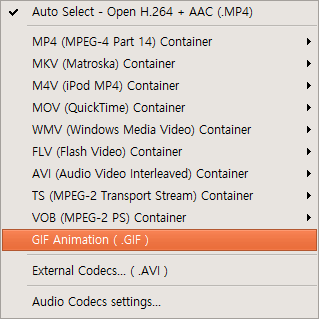
The default video codec is Open H.264 + AAC (.MP4).
In addition, MPEG-1, MPEG-2, MPEG-4, XVID, OpenDivX, Microsoft MPEG-4 Part 2, and Microsoft MPEG-4 Part 3 are also supported.
All of these codecs are saved in MP4 or AVI container formats.
oCam records using optimized codecs at installation time, and when these codecs are used, the recorded files can be played on almost all media players without installing additional codecs, unlike many other screen recording programs.
Usually, you may need to install codecs to play a recorded video, but with these codecs, most are supported by default.
This means that you can play oCam-recorded video files directly in Windows Media Player immediately after installing Windows without installing any additional software.
So there is no extra hassle of having to install extra codecs.
Also, MPEG-4, XVID, and OpenDivX are internally encoded with the MPEG-4 codec in oCam, with only the FourCC value changed for XVID and OpenDivX.
Additionally, supported container formats include FLV.
FLV stands for Flash Video and supports live streaming, so you can upload FLV files directly to places like a Zboard forum and preview them immediately on the web.
You can also use an FLV player. FLV is encoded with the MPEG-4 codec in oCam.
For Apple’s QuickTime format, MOV is a QuickTime-only format and uses the MPEG-4 codec.
Also, MPEG-2 Transport Stream has the .TS extension, and MPEG-PS has the .VOB extension; both use MPEG-2 as the codec.
If you choose GIF animation for creating animations, you can make a moving image.
Finally, all audio codecs used during video recording are saved as MP3.
Additionally, external codecs are supported; please refer to a separate post for details on external codecs.