Recommended




How to Add a Custom Watermark to Recorded Videos
Using oCam at work or school? A license is required, and it removes all ads, including this window. See the paid version →
Adding a watermark to videos recorded with oCam helps clearly indicate the source of the video and reduce the chance of unauthorized use by others. A watermark is a feature that inserts a specific image into the video, such as a logo, text, or icon, to identify the creator or ownership. This is effective for protecting the uniqueness of the video and promoting your brand.
To add a watermark in oCam, first click 'Tools' in the top menu of the oCam main window, then select 'Options'. When the Settings window opens, click 'Watermark' in the left menu to go to the watermark settings screen.
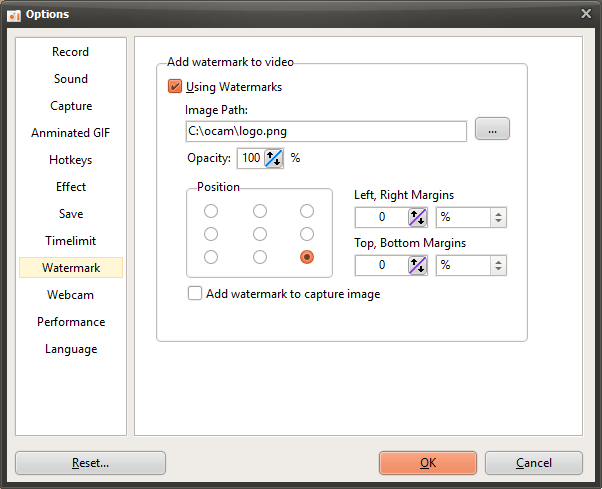
On the watermark settings screen, you can adjust several options. First, if you check 'Use Watermark', the selected image will be inserted as a watermark in the recorded video. You can choose the image to use as the watermark under 'Image Path', and PNG, JPG, and BMP formats are supported. PNG format in particular also supports images with an alpha channel (transparency), so you can use logos or images with transparent backgrounds.
The 'Opacity' setting adjusts the transparency of the watermark image. If the opacity is set to 100%, the watermark image will appear fully opaque. The lower the value, the more transparent the image becomes, allowing it to blend more naturally into the video. This lets you adjust the watermark so it does not interfere with the readability of the video.
The 'Position' setting determines where the watermark appears in the video. For example, you can choose the top left or bottom right so the watermark appears in the desired area of the screen. This allows you to place the watermark without covering the main content of the video.
For example, if you set a specific logo image as the watermark and start recording, that image will appear as a watermark at the selected position in the final video. A watermark added in this way makes the source of the video clear and helps viewers easily identify the creator.
If you want to create your own watermark image, search for "create watermark" on a search site to find various design tools and methods. For example, you can use graphic editing programs such as Photoshop or Canva to create a logo or text, or use an online watermark generator to easily create a distinctive watermark.
Using the watermark feature in oCam, you can give your videos a more professional and secure finish with just a few simple settings. Try creating your own unique videos with the right image and settings.
Programs
Another helpful tip
Can I record only the computer's system audio and save it as an MP3?
oCam now supports audio recording as well as video recording.
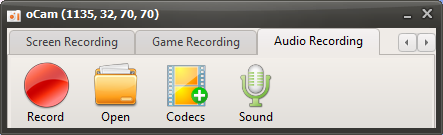
Click the Audio Recording tab on the oCam main screen to open a user-friendly and simple menu. This menu is designed to provide various recording options so users can adjust the settings as needed. One of oCam's strengths is its intuitive interface, which makes it easy to use for everyone from beginners to IT professionals.
Depending on your needs, you can use this feature to record only audio, such as for audio content creation, podcast recording, or capturing background music.
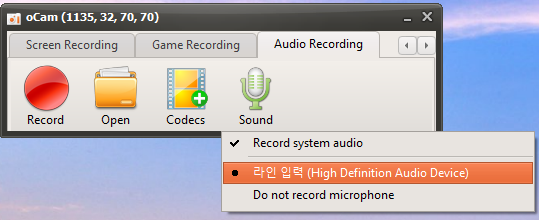
Click the Sound button to select the audio source, such as system audio or microphone input settings, then click the Record button on the screen to start recording. This feature is very useful for tasks that require audio-only recording. For example, it is efficient when you want to extract lecture audio separately, record an interview, or make a simple voice recording. Thanks to oCam's simple controls, these setting changes can be completed in just a few clicks, maximizing user convenience.
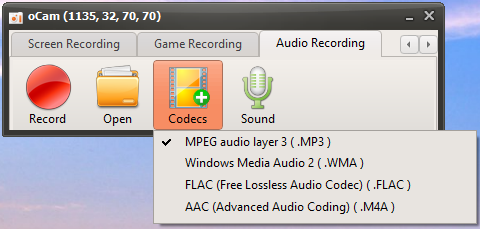
By default, audio files are saved in MP3 format. MP3 is one of the most widely used formats for audio recording because it offers small file sizes and excellent compatibility with most devices and software. This format provides a good balance between audio quality and file size, making it suitable for general use. However, for users with more specific requirements, oCam also provides an option to choose audio codecs other than MP3 through the Codec button. If you select AAC format, you can maintain high audio quality with efficient compression, making it a flexible choice depending on the project.
This setup process clearly shows how simple yet powerful oCam is. oCam is more than just a screen recording tool; it is versatile software that also supports professional audio recording tasks. Users can further adjust details such as the file save path, audio quality, and input sources in the settings menu. For example, you can adjust the volume levels of the microphone and system audio separately, or set a save folder to optimize your workflow. Thanks to this flexibility and convenience, oCam is used in a wide range of environments, from personal use to professional IT work. If you want high-quality audio recording, it is recommended to adjust the codec and detailed settings to suit your environment and achieve the best results.