Recommended

oCam Advanced Settings - Capture
Using oCam at work or school? A license is required, and it removes all ads, including this window. See the paid version →
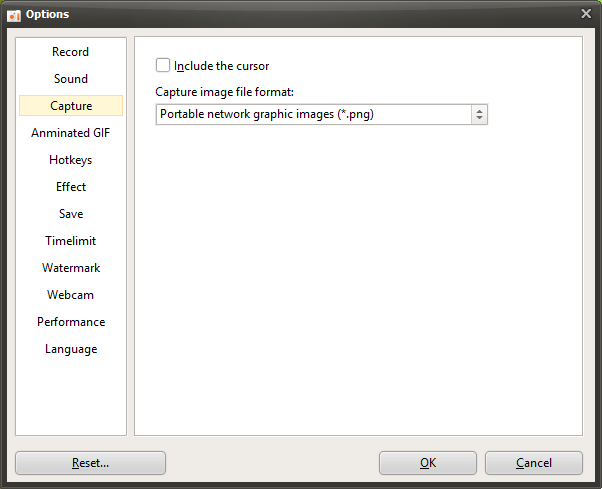
oCam is a multifunctional program that not only supports screen recording but also provides a screen capture feature, allowing users to save specific moments on the screen as images easily. In the settings window that appears when you click the "Tools - Options" menu, the "Capture" category on the left provides options for adjusting settings related to screen capture. This tab is designed so users can customize the details of the capture feature, and it can be used intuitively by everyone from beginners to IT professionals. Below is a detailed explanation of the main settings in the "Capture" category.
Overview of the Capture Feature
The settings in the "Capture" category are the options that apply when you click the "Capture" button in the main oCam window or press the default hotkey (F3). Through these settings, users can choose the format of the captured image and decide whether to include additional elements such as the mouse cursor. The capture feature is very useful when creating tutorials, preparing software documentation, or saving a specific moment on the screen.
Include Mouse Cursor
The "Include Mouse Cursor" option determines whether the mouse cursor will be included in the captured image. By default, this option is unchecked, so the mouse cursor is not included in captured images. This is suitable when you want a clean image. However, if you want to highlight the cursor position for lecture materials or software usage guides, you can check this option to include the cursor in the image. For example, when capturing the process of clicking a specific button, including the cursor can make the material visually clearer.
Image File Format for Capture
The "Image File Format for Capture" setting lets you choose the file format used to save captured images. oCam supports several image formats, and by default it is set to PNG. PNG is the most recommended format because it provides lossless compression, allowing you to save clear images without any loss in quality. Other supported formats may include JPEG and BMP. JPEG is useful when you want to reduce file size, but it may cause some loss of image quality. Users can choose the most appropriate format by considering storage space, image quality requirements, or compatibility with a particular platform.
Usage Tips
The settings in the "Capture" category are simple, but they play an important role in improving how captured images can be used. For example, when creating tutorials, enabling the "Include Mouse Cursor" option can clearly show where the user is clicking or interacting. Using PNG format by default helps maintain high image quality, making it suitable for professional documentation. On the other hand, if minimizing file size is important, you can choose JPEG format to save storage space. If you often use the capture hotkey (F3), changing it to a different key or becoming familiar with it can also help improve your workflow.
In addition, if you want to review and edit captured images immediately after saving them, it is a good idea to set the save location in advance in oCam. This makes it easier to find and use captured images quickly. If you are capturing the UI of specific software or a game screen, be sure to define the capture area accurately so that unnecessary parts are not included.
Programs
Another helpful tip
What Are Codecs and Digital Container Formats?
When using oCam normally, you do not need an in-depth understanding of codecs and digital container formats. However, if you want to use oCam's extended features or optimize your recording settings, it is useful to understand these two terms. Below is an easy explanation of codecs and digital container formats, focused on how they relate to oCam.
* What is a digital container format?
A digital container format refers to familiar file extensions such as AVI, MP4, MOV, and FLV. It is a meta file format that defines the structure for storing video, audio, and metadata (for example, subtitles and time information) together in a single file. Simply put, you can think of a container format as the framework of a file structure that determines how video and audio data are stored.
For more information, see Wikipedia:
https://en.wikipedia.org/wiki/Container_format
For example, if a file is an AVI file, the container format is AVI, and the video and audio data inside that file are stored according to the structure defined by AVI. A container format acts like a "container" that holds the data, while the actual method used to encode the data is determined by the codec.
* What is a codec?
A codec is hardware or software that performs encoding and decoding. It includes algorithms for compressing data, decompressing it, or converting it into another format. In oCam, codecs are used to convert screen video data into a video file and to generate audio data. The generated data is then saved according to the digital container format selected by the user.
For more information about codecs, see Wikipedia:
https://en.wikipedia.org/wiki/CodecSimply put, a codec is a tool that compresses and converts video or audio data so it can be stored or played back efficiently. Common codecs used in oCam include XVID, MPEG-1, MPEG-2, MPEG-4, and H.264, while common audio codecs include MP3 and PCM.
* Codecs and container formats in oCam
In oCam, a codec is used to encode video and audio data in order to convert screen recording data into a video file. This encoded data is then saved as a file in the digital container format selected by the user, such as AVI or MP4. For example:
- If the file extension is AVI, the container format is AVI, and the video data inside may be encoded with H.264 or MPEG-4. The audio data may be saved as MP3 or PCM.
- In the case of an MP4 file, the container format is MP4, and it may similarly contain video encoded with H.264 and audio encoded with MP3.
* Summary
In oCam, the digital container format is the framework that defines the file structure, such as AVI or MP4, while the codec is the method used to compress and convert the video and audio data inside it, such as H.264 or MP3. oCam's default settings are enough for high-quality recording, but depending on your specific purpose, such as optimizing file size or improving editing compatibility, adjusting the codec and container format can make your workflow more efficient. If needed, try selecting the codec and format you want in oCam's codec settings menu.