Recommended



How to Record Losslessly Using x264vfw
Using oCam at work or school? A license is required, and it removes all ads, including this window. See the paid version →
Before getting started, you must install the x264 codec in advance. If you do not know how to install it, please refer to the Help section.
Click the Codec menu in oCam, then click the External Codec menu item.
Select Use External Codec, choose the x264vfw codec, and then click the Settings button.
Using the default x264vfw settings as a base, change the parts highlighted in the yellow box in the image below as shown.
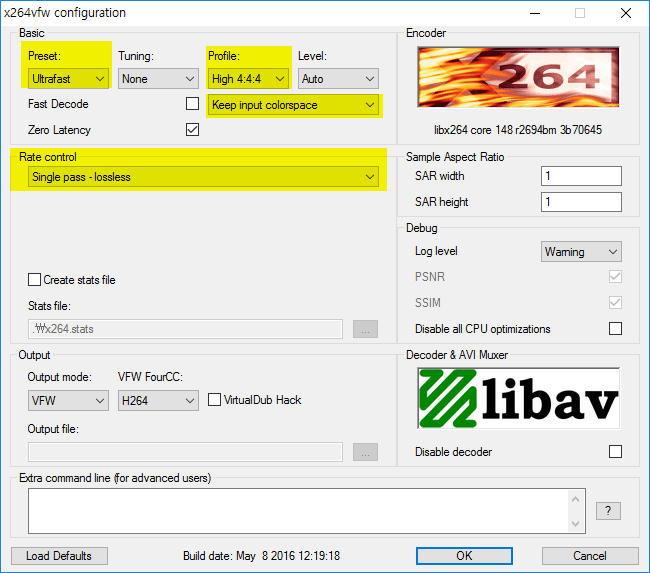
The following settings need to be changed.
Preset - Ultrafast ( Set this to improve encoding speed. The file size may become larger, but if you choose other options, significant lag may occur. )
Profile - High 4:4:4 ( The default profile may cause quality loss, so change it to High 4:4:4 for lossless encoding. )
Keep input colorspace - Keeps the color space of the internally received input buffer. ( If you use other options, encoding may fail. )
Rate control - Single pass - lossless - Change this for lossless encoding.
Click the OK button to apply the settings.
When recording 64-bit games, the settings are applied to x264vfw64 for 64-bit, so run x264vfw - Configure x264vfw64 from the Start menu and configure it in the same way as shown above.
If you record with the above settings, the video will be recorded losslessly. One important point is that if you want to play back the lossless video without quality loss, you must change the settings in your video player.
Below is how to check a lossless video using PotPlayer.
Run PotPlayer, then click Preferences ( F5 ).
In the Preferences window,
click Video - Color Space/Attributes on the left, then in the Color Space group box on the right, select Convert manually if possible - Default output color space. ( If you do not configure this, even if the recording is lossless, the screen colors may still be altered during playback. )
Click OK, then play the video recorded losslessly.
At this point, press Ctrl + F1 in PotPlayer. As shown below, the output format of the video codec must be displayed as RGB(32 Bits).
Also, in the playback information under the File Information tab, the following properties must match as shown below.
Format profile : High 4:4:4 Predictive@L3
Color space : RGB
Color range : Full
Matrix coefficients : RGB
Please note that Windows Media Player does not play this properly, and preview thumbnails will not be displayed in Windows Explorer.
Programs
Another helpful tip
How to Add a Custom Watermark to Recorded Videos
Adding a watermark to videos recorded with oCam helps clearly indicate the source of the video and reduce the chance of unauthorized use by others. A watermark is a feature that inserts a specific image into the video, such as a logo, text, or icon, to identify the creator or ownership. This is effective for protecting the uniqueness of the video and promoting your brand.
To add a watermark in oCam, first click 'Tools' in the top menu of the oCam main window, then select 'Options'. When the Settings window opens, click 'Watermark' in the left menu to go to the watermark settings screen.
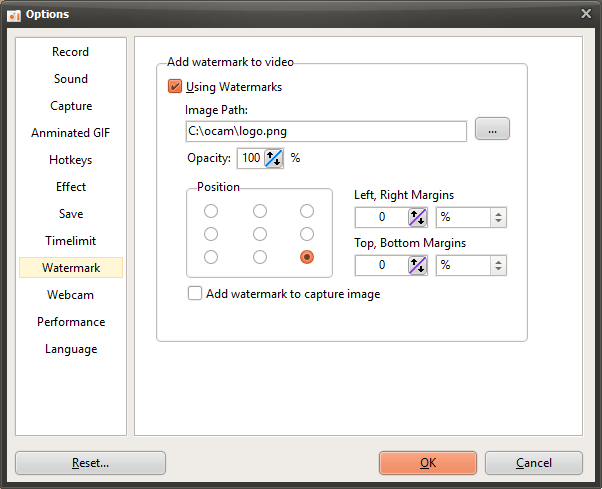
On the watermark settings screen, you can adjust several options. First, if you check 'Use Watermark', the selected image will be inserted as a watermark in the recorded video. You can choose the image to use as the watermark under 'Image Path', and PNG, JPG, and BMP formats are supported. PNG format in particular also supports images with an alpha channel (transparency), so you can use logos or images with transparent backgrounds.
The 'Opacity' setting adjusts the transparency of the watermark image. If the opacity is set to 100%, the watermark image will appear fully opaque. The lower the value, the more transparent the image becomes, allowing it to blend more naturally into the video. This lets you adjust the watermark so it does not interfere with the readability of the video.
The 'Position' setting determines where the watermark appears in the video. For example, you can choose the top left or bottom right so the watermark appears in the desired area of the screen. This allows you to place the watermark without covering the main content of the video.
For example, if you set a specific logo image as the watermark and start recording, that image will appear as a watermark at the selected position in the final video. A watermark added in this way makes the source of the video clear and helps viewers easily identify the creator.
If you want to create your own watermark image, search for "create watermark" on a search site to find various design tools and methods. For example, you can use graphic editing programs such as Photoshop or Canva to create a logo or text, or use an online watermark generator to easily create a distinctive watermark.
Using the watermark feature in oCam, you can give your videos a more professional and secure finish with just a few simple settings. Try creating your own unique videos with the right image and settings.